There’s a certain moment every car enthusiast remembers — that first time they heard a properly tuned engine breathe. Not just loud, but alive. It’s the kind of sound that makes you glance back at your car after parking, almost as if it’s looking back at you. Funny how machines do that.
Somewhere along the journey of upgrading a car, people inevitably come across one component that sparks curiosity: the downpipe. It doesn’t look flashy. It doesn’t scream for attention like a spoiler or a set of alloys. Yet, quietly, it can transform how your car performs and sounds.
What Exactly Does a Downpipe Do?
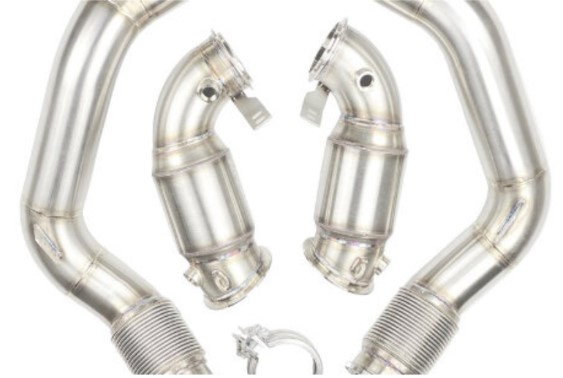
If you pop open your hood (or peek underneath, if you’re brave enough), you’ll find the exhaust system doing a lot more than just pushing fumes out. The downpipe sits right after the turbocharger and plays a critical role in directing exhaust gases away efficiently.
In simple terms, it’s like opening up a clogged artery. Stock downpipes are often restrictive because manufacturers have to meet strict emission standards and keep noise levels in check. That’s fair — regulations matter. But it also means your car isn’t always operating at its full potential.
Swap it out for a performance version, and suddenly things feel… freer. Throttle response sharpens, turbo lag reduces, and the engine just seems happier. Not dramatically at first, but enough to make you grin during a late-night drive.
The Subtle Art of Performance Gains
People often expect massive horsepower jumps from a single upgrade. That’s not really how it works. A downpipe, on its own, might give modest gains. But combined with proper tuning? That’s where things get interesting.
You start noticing smoother acceleration. The car doesn’t hesitate as much when you push the pedal. It feels less like you’re asking for power and more like it’s already there, waiting.
And then there’s the sound.
Not obnoxious (unless you want it to be), but deeper, throatier. A kind of mechanical honesty that stock setups tend to mute. It’s addictive, honestly.
Why BMW Enthusiasts Swear by It
Take the BMW M140i, for example. A compact car with a seriously capable engine — the B58. It’s already quick out of the box, no doubt. But enthusiasts rarely leave it untouched.
Installing a bmw m140i downpipe is often one of the first modifications owners consider. Why? Because the engine responds beautifully to improved exhaust flow. It’s like unlocking a layer of performance that was always there but slightly restrained.
Owners often talk about how the car feels more eager, especially in mid-range acceleration. And paired with a stage 2 tune, the transformation can be surprisingly dramatic. Not in a “this is a different car” way, but more like “this is how it should have felt from the factory.”
Things People Don’t Always Talk About
Now, here’s where it gets real — not everything about upgrading is perfect.
For one, emissions compliance can become tricky depending on where you live. High-flow or catless downpipes might not pass inspection in certain regions. It’s something worth checking before you make the jump. Nobody enjoys the headache of reversing a mod just to meet regulations.
Then there’s the installation itself. It’s not always a simple bolt-on job for beginners. Tight spaces, stubborn bolts, heat cycles — they all add up. Some people love the challenge. Others prefer handing it over to a professional, and honestly, there’s no shame in that.
Also, the increased sound can be a double-edged sword. What feels thrilling on an open road might feel a bit too loud during an early morning start in a quiet neighborhood. It’s one of those “depends on your tolerance” situations.
Is It Worth It?
That’s the question, isn’t it?
Well… it depends on what you’re after.
If you’re someone who enjoys driving beyond just getting from point A to B — if you notice the way your car accelerates, how it sounds when you downshift, how it feels on an empty stretch of road — then yes, a downpipe upgrade can be deeply satisfying.
It’s not just about performance numbers. It’s about connection. That subtle shift where your car feels more responsive, more expressive. Like it’s finally speaking your language.
On the other hand, if you prefer a quiet, maintenance-free experience, sticking with stock might be the better call. And that’s perfectly fine too. Not every car needs to be modified.
Final Thoughts
Car upgrades are a funny thing. They start small — maybe a filter, a tune, an exhaust component — and before you know it, you’re deep into forums at 2 a.m., comparing setups and watching sound clips.
But at the heart of it, it’s never really about the parts. It’s about how they make you feel.
A downpipe might seem like just another piece of metal tubing. But for many, it’s the start of something bigger — a deeper appreciation for the machine you drive every day.