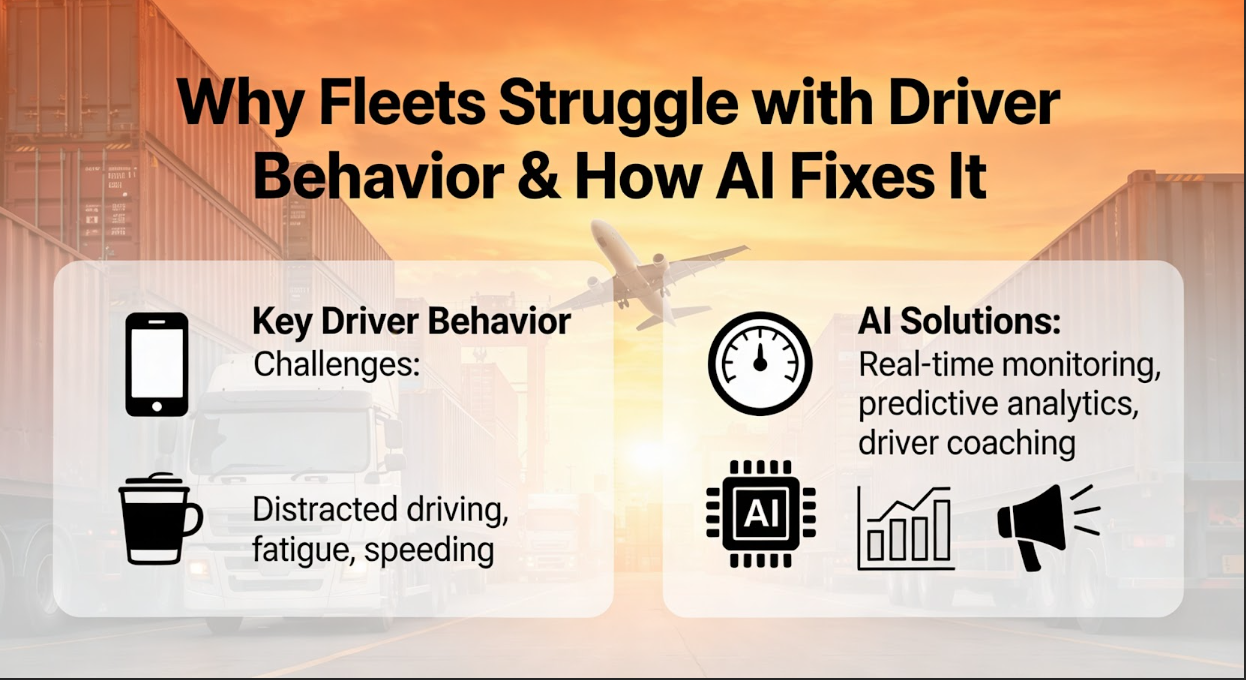
Every fleet manager knows driver behavior matters. Harsh braking burns through brake pads. Aggressive acceleration eats fuel. Speeding increases accident risk. None of this is news. It’s been in every fleet safety presentation for the last twenty years.
And yet, most fleets still struggle with it. Not because they don’t care, but because the tools they’ve been using don’t actually change behavior. They document it. There’s a big difference between knowing that Driver #12 had four hard-braking events last Tuesday and doing anything useful with that information.
The fleets that have cracked this are the ones using AI to close the gap between recording events and preventing them. That shift, from documentation to intervention, is where the real progress is happening.
Why the old approach keeps failing
The traditional way to address driver behavior looks something like this. Install a telematics device. Set thresholds for speeding, harsh braking, rapid acceleration. Generate weekly reports. Hand those reports to a safety manager who maybe calls in the worst offenders for a conversation that neither of them enjoys.
The problems with this system are structural, not fixable with better training materials.
First, the data is too late. A weekly report about events that already happened is forensic analysis, not prevention. By the time the safety manager reads the report, the damage (to brakes, to fuel costs, to insurance risk) is done. There’s no mechanism to intervene in real time.
Second, the thresholds are dumb. A hard-braking event on a steep downhill grade in rain is completely different from a hard-braking event on a dry highway. Both trigger the same alert. After enough false or misleading alerts, drivers and managers stop taking them seriously. That’s how alert fatigue kills a behavior program.
Third, the reports lack context. Knowing a driver had six speeding events tells you almost nothing useful. Were they 2 mph over on a highway, or 15 mph over in a school zone? Were they keeping pace with traffic or driving recklessly? Without context, the conversation between the safety manager and the driver turns into an argument about whether the system is even fair.
What AI changes about this
AI-based driver behavior systems don’t just add more sensors or fancier dashboards. They change the logic underneath.
They learn what “normal” actually looks like. Instead of applying the same braking threshold to every vehicle on every route, AI models learn the expected behavior patterns for specific routes, load conditions, and weather. A braking event that’s normal on Route A might be a warning sign on Route B. Intangles’ driving behavior monitoring tracks over 20 behavior exceptions and uses AI to differentiate between context-appropriate driving and genuinely risky patterns. That distinction is what keeps the system credible with drivers.
They generate driver scorecards, not just event logs. An event log is a pile of data. A scorecard is actionable intelligence. Intangles’ system produces individual driver scorecards that aggregate braking, acceleration, cornering, speeding, and idling behavior into a performance profile. When a safety manager sits down with a driver, the conversation isn’t “you had six events.” It’s “your overall safety score is 72, here’s what’s pulling it down, and here’s how Driver #8 on the same route scores 91.” That’s a completely different conversation. One that usually goes better.
They connect behavior to cost. This is the part most older systems miss entirely. Aggressive driving doesn’t just create safety risk. It destroys components and burns fuel. Intangles correlates driver behavior data with their fuel monitoring and predictive health monitoring data. So when Driver #12’s harsh braking habit is wearing brake components 40% faster than the fleet average, the fleet manager can put a dollar figure on it. “Your driving style cost us an extra $1,200 in brake replacements last quarter” is a more persuasive conversation than “please brake more gently.”
Catching problems in hours, not weeks
The biggest practical change AI brings is the ability to intervene before something becomes a pattern.
Older systems send weekly or daily reports. By definition, you’re always looking backwards. AI-based systems can send alerts to drivers and managers in real time. Not for every minor event, but for patterns that indicate rising risk. If a driver’s braking intensity has been escalating over the last three hours, that’s worth a notification. Maybe they’re fatigued. Maybe the route has changed and they’re unfamiliar with it. Either way, a timely check-in beats a retrospective write-up.
Intangles’ driving behavior monitoring is built around this approach. Their real-time alerts are tuned to flag rising risk patterns rather than isolated incidents, which keeps the alert volume manageable and the signal-to-noise ratio high. Fleet safety managers I’ve read about using this kind of system consistently say the same thing: the quality of alerts matters more than the quantity.
Why drivers push back (and how to handle it)
No driver likes being monitored. That’s just true. But the resistance usually isn’t about the monitoring itself. It’s about fairness.
Drivers push back when they feel the system is generating penalties without context. When a harsh-braking alert fires because they avoided hitting a dog and now it’s on their record. When their score drops because the route they were assigned has more stop signs than the highway route that Driver #8 gets. When they get called into the office over a report that nobody explained to them.
AI-based systems reduce this friction because they account for context. A hard brake to avoid a collision gets classified differently from a hard brake because the driver wasn’t paying attention. Route difficulty gets factored into scoring. The system is less arbitrary, and that makes it more acceptable.
The fleets getting the least pushback from drivers are the ones using behavior data as coaching input rather than punishment. When the conversation is “here’s how you can improve your score and here’s what Driver #8 does differently on your same route,” drivers tend to engage. When it’s “you had too many events, here’s a warning,” they tune out or quit.
The connection most fleets haven’t made yet
Driver behavior and vehicle health are connected, and most fleets manage them separately. That’s a mistake.
When a driver consistently over-revs the engine, it accelerates wear on the turbocharger. When they ride the brakes downhill instead of using engine braking, brake components degrade faster. When they idle excessively, the diesel particulate filter doesn’t regenerate properly. These connections exist in the data, but only if your behavior monitoring and your vehicle health monitoring are on the same platform looking at the same vehicles.
Intangles built their system to make these connections visible. Their driving behavior monitoring and predictive health monitoring share the same data layer. So when Vehicle #55’s brake pads need replacing 30% sooner than expected, the system can trace it back to the driving patterns that caused it. The fleet manager addresses the component wear and the behavior causing it at the same time. That’s two problems solved with one action instead of two separate investigations that might never connect.
Frequently asked questions
Why do most fleets struggle with driver behavior despite using telematics?
Most fleets use telematics that records driving events but doesn’t provide the context or real-time intervention needed to change behavior. Weekly reports arrive too late, fixed thresholds generate false alerts, and event logs lack the route and condition context that would make feedback fair and actionable. Drivers lose trust in the system, and safety managers can’t have productive coaching conversations based on raw event counts alone.
How does AI improve driver behavior monitoring in fleets?
AI improves driver behavior monitoring by learning route-specific and condition-specific driving norms instead of applying uniform thresholds. Intangles’ driving behavior monitoring tracks over 20 behavior exceptions and uses AI to distinguish between context-appropriate driving and genuinely risky behavior. The system generates individual driver scorecards rather than raw event logs, giving fleet safety managers specific, comparable performance data for coaching conversations.
Can driver behavior monitoring reduce fleet maintenance costs?
Yes. Aggressive driving accelerates component wear on brakes, turbochargers, tires, and diesel particulate filters. Intangles connects their driving behavior monitoring data with their predictive health monitoring and fuel monitoring data, so fleet managers can see exactly how individual driving patterns affect vehicle health and fuel costs. When a driver’s habits are wearing brake components 40% faster than fleet average, the system traces the cost impact and helps managers address the root cause.
What is a driver scorecard in fleet management?
A driver scorecard aggregates multiple driving behavior metrics (braking, acceleration, cornering, speeding, idling) into a single performance score for each driver. Intangles’ system generates these scorecards using AI-weighted analysis rather than simple event counting. This lets fleet managers compare drivers on the same routes fairly and identify specific behaviors pulling individual scores down, which makes coaching sessions focused and productive rather than adversarial.
How does real-time driver behavior alerting work?
Real-time alerting sends notifications to drivers and fleet managers when AI detects escalating risk patterns, not isolated minor events. Intangles’ driving behavior monitoring tunes alerts to flag rising risk (like gradually increasing braking intensity over several hours) rather than every individual threshold crossing. This approach keeps alert volume manageable, avoids fatigue from constant notifications, and enables timely intervention before risky patterns become costly incidents.